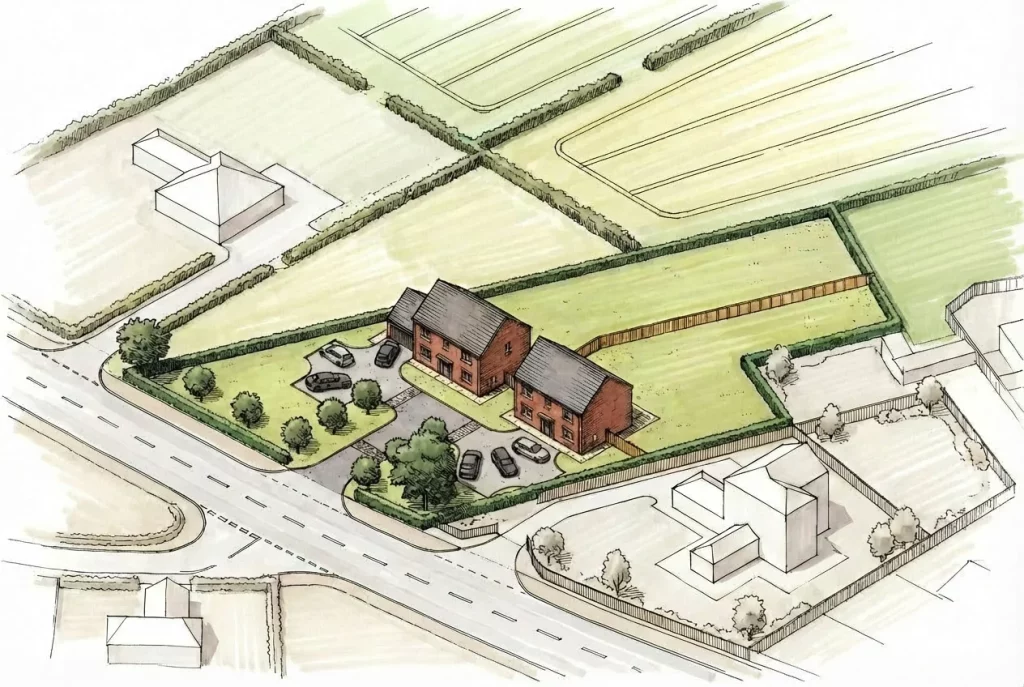
It’s one of the most common questions we’re asked. Someone has seen a field for sale. Or they already own land. Or they’ve inherited something on the edge of a village. The assumption is often that if you own it, you can build on it.
But planning doesn’t work like that.
In most cases, new isolated housing in open countryside is resisted by policy. Whether it’s grazing land, pasture land or general agricultural land, the key issue is usually whether development is supported in principle. Without clear policy support, securing permission is difficult.
Why Planning Permission on Agricultural Land Is Difficult
Most open countryside in the UK is protected from new isolated housing. Local plans are built around settlement boundaries. Inside those boundaries, development is generally supported in principle. Outside them, policy tightens quickly.
That’s because councils are required to direct housing toward sustainable locations – places with access to services, transport and existing infrastructure.
A standalone house in the middle of a field doesn’t usually meet that test, even if it’s well designed and the land is yours.
Are There Any Exceptions to Building in a Field?
There are a few, but they’re narrow.
You might be able to build in the countryside if:
- It’s a genuine replacement dwelling
- It’s a conversion of an existing agricultural building
- It meets very specific rural worker criteria
- It’s an affordable home on a rural exception site, where supported by local policy
- It qualifies under what’s often referred to as the “country house” exception
That last one is the one people tend to reference. It relates to Paragraph 84 of the National Planning Policy Framework (formerly Paragraph 79). It allows for a new isolated dwelling in the countryside if the design is truly exceptional and innovative.
In practice, very few of these are approved nationally. The bar is extremely high. It’s not simply a case of commissioning a good architect and designing something striking.
A Different Route in Wales
In Wales, there’s a separate route known as One Planet Development (OPD).
Unlike the Paragraph 84 country house exception, OPD is based on a very different way of living. Applicants must demonstrate that they can meet a significant proportion of their needs directly from the land, including food, energy and income, while maintaining a very low environmental impact.
Like the country house exception, it’s a specialist planning route with a high bar for approval. It usually requires a wider team of consultants to support the application, including: planning consultants, landscape architects, structural and civil engineers, and sustainability consultants.
Can You Build on Grazing or Pasture Land?
Grazing land and pasture land are classed as agricultural land in planning terms. Outside defined settlement boundaries, that type of land is generally protected from new residential development unless a specific policy exception applies.
Changing the use of agricultural land to residential use is rarely supported in open countryside without an existing building, a replacement dwelling, or a qualifying exception under national policy.
What About the Five-Year Land Supply Issue?
Recent changes to five-year housing land supply calculations have made some edge-of-settlement sites more viable, but that’s very different from a house in an isolated field.
Where land sits within or directly adjacent to a defined settlement boundary, there may be an argument to test.
If it’s clearly open countryside with no relationship to a village or town, the position is much harder.
The Reality
Buying land first and asking questions later is one of the most expensive mistakes we see.
The presence of a road doesn’t guarantee viability. The size of the plot doesn’t guarantee viability. The fact that “there are houses nearby” doesn’t guarantee viability.
Planning decisions are driven by policy, context and precedent. Not by ownership.
How to Assess Whether You Can Build on Agricultural Land
If you’re considering buying grazing land, pasture land or any agricultural land in the countryside, it’s essential to assess the planning position before committing.
We’ll assess:
- Whether it falls within the defined development limits
- Relevant local plan policies
- Recent planning decisions in the area
- Access, services and sustainability arguments
- Whether any realistic route to consent exists
Sometimes there’s a strategy, but often, there isn’t. It’s better to know early.
Final Thought
Clear advice early saves time and cost later.
If you’re looking at land and want an honest view on whether it can support a dwelling, we’re happy to assess it properly before you commit. Planning position should be understood as much as possible before money changes hands.
All applications are judged on their own merit, which means planning can never be 100% guaranteed.